Externalized Authorization vs Inline Permission Checks
Centralizing permission checks prevents drift and security holes as systems scale.
A permission check that starts as a single line of code, if user.role == "admin": return True, is rarely the problem. What happens to that line over three years of feature requests, tenant onboarding, and department-specific exceptions is the problem. Inline authorization logic is a fine way to ship a first version of anything. It is a bad way to run a system once roles multiply, once partners need scoped access, once regional rules diverge. Externalized authorization exists because the alternative, scattered conditionals reimplemented service by service, is a coding style that has turned into a governance liability.
For a brand-new service with two or three roles and a handful of endpoints, the conditional does the job. There's no reason to stand up a policy engine to check whether someone is an admin. But that same instinct, repeated at every decision point across a growing codebase, is what sets up the failure modes below.
The failure modes that emerge as inline checks accumulate
Policy drift is the quiet one. The same authorization intent, "only admins can delete this record", gets implemented in the billing service, then again in the reporting service, then again in whatever gets built next quarter. Each implementation is a separate guess at what the rule means. Over time the guesses diverge: one service allows what another denies, and nobody notices until a security review, or worse, an incident, forces someone to line the implementations up side by side.
Spaghetti code follows close behind. Authorization logic that starts clean gets tangled with business logic as requirements change, until a developer can't touch the conditional without risking the business rule next to it, or touch the business rule without risking the conditional. Neither can be changed safely in isolation anymore.
Microservices make this worse, not better. Extracting the checks into a shared library sounds like the fix, until the shop is running Node.js for the API layer, Python for the data pipeline, Java for the legacy core, and Ruby for whatever the original team wrote years earlier. That's four separate implementations of the same rule, in four languages, updated on four different release schedules. A change to the policy means a synchronized rollout across all of them, and if any one service's interpretation drifts even slightly from the others, the result is a real security hole, not a hypothetical one.
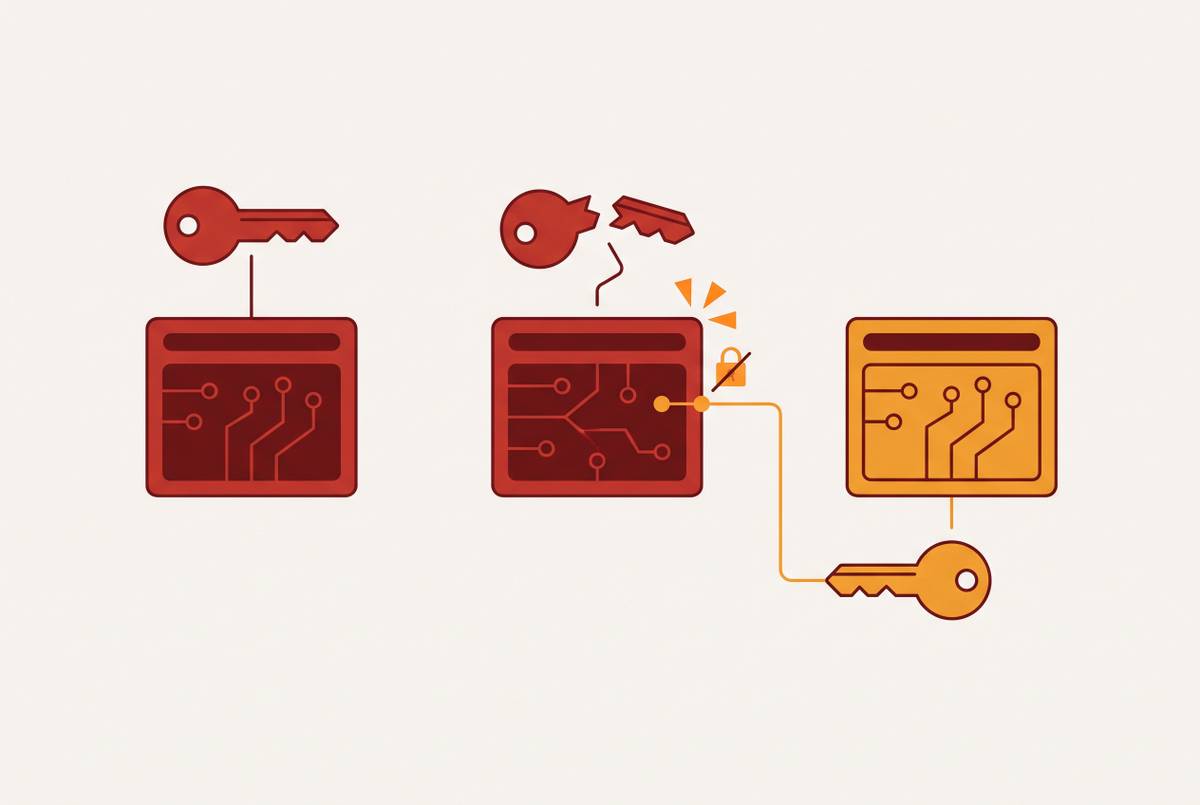
Then there's the staleness built into JWTs themselves. Tokens are built to carry identity and a snapshot of claims, not real-time permission state. A user removed from an admin group still holds a valid token with the old claim until that token expires or a cache refreshes. The system enforces a permission that no longer exists, for a window that's entirely dependent on cache configuration rather than the actual state of who should have access to what.
What the security exposure looks like at this scale
OWASP's Top 10 for 2025 places Broken Access Control at the number one spot, the single largest category of application security risk it tracks, spanning 40 distinct CWEs, with 3.73% of tested applications found to have one or more weaknesses in that category. OWASP's Top 10 for 2025 places Broken Access Control at the number one spot, the single largest category of risk it identifies, mapping directly onto the drift and sprawl described above. It's the single largest category of risk OWASP identifies, and it maps directly onto the drift and sprawl described above.
In practice, broken access control looks like a URL parameter changed from ?user_id=1042 to ?user_id=1043 to pull up someone else's account records. It looks like a JWT token altered client-side to escalate a role claim before the request hits a server that trusts the token's contents without re-verifying them against a policy. It looks like a function-level restriction that exists on the web UI but was never enforced on the API endpoint underneath it, so the restriction was cosmetic the entire time.
Much of this traces back to a basic mix-up between two different jobs. Authentication answers "who is this." Authorization answers "what can they do." Plenty of teams pour real engineering effort into the front door, multi-factor login, password hashing, session management, and then treat everything past that door as settled, when the interior is where the scattered conditionals actually live.
Non-human identities raise the stakes further. Machine identities, service accounts, and workload credentials now outnumber human users in most environments, and 97% of them carry excessive privileges. When authorization logic is fragmented across services, that over-permissioning problem doesn't stay contained to one identity or one service. It propagates across every machine identity the fragmented model touches.
What externalized authorization means architecturally
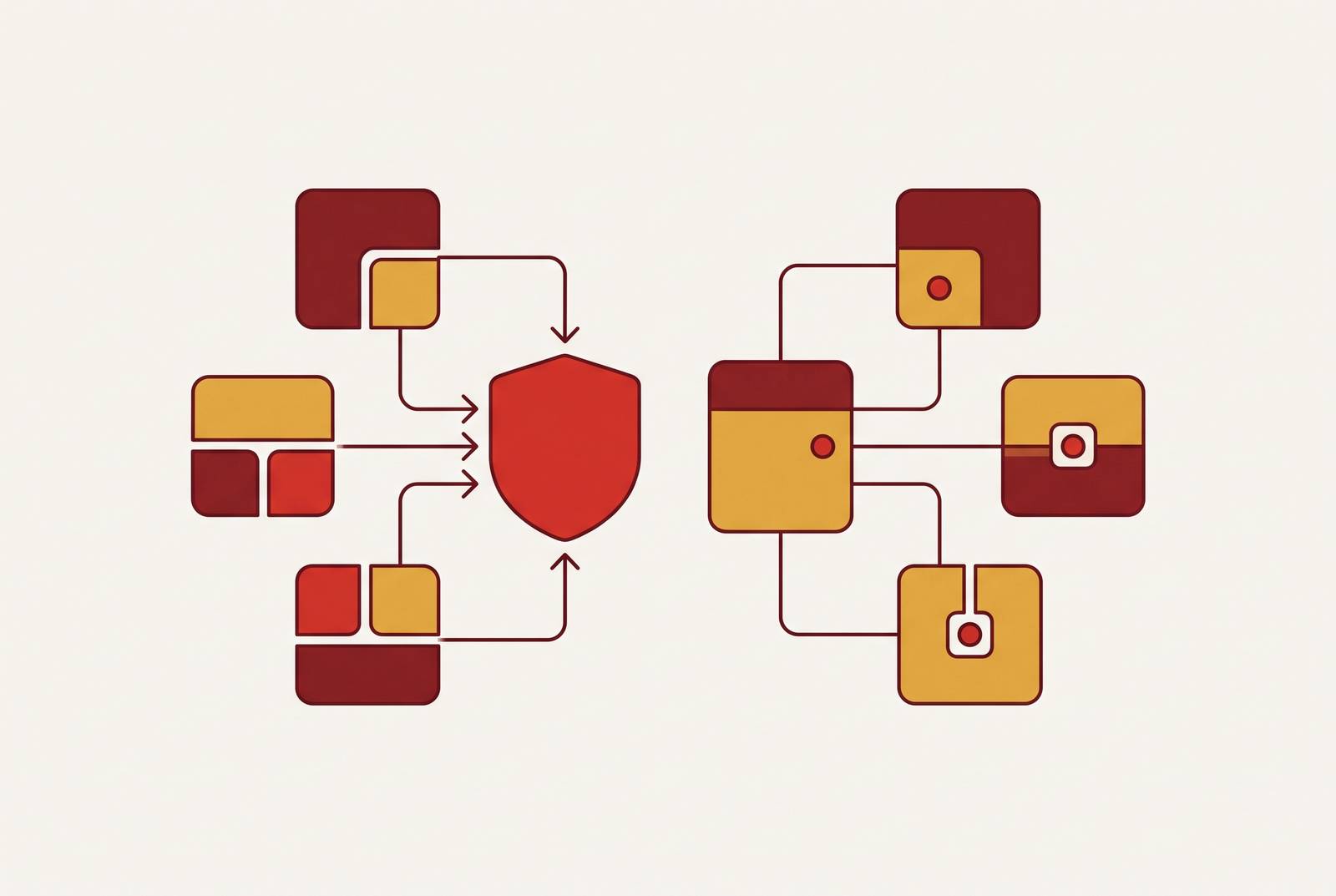
Externalized authorization means the application stops deciding for itself and asks instead. Rather than a service computing its own yes-or-no answer through a conditional, it sends a request to a separate policy engine and gets a decision back.
The architecture splits the work into two roles. The Policy Decision Point, the PDP, holds the centrally managed policy and evaluates each request against it. The Policy Enforcement Point sits inside the application and asks the question: can this subject perform this action on this resource? The application's job shrinks down to supplying the action and the resource; the identity layer supplies who's asking; the policy engine supplies the verdict. Nobody downstream of the PDP is guessing at what the rule says, because there's only one place the rule is written.
What the engine weighs when it makes that decision includes role membership, how sensitive the data is, which tenant the request belongs to, the posture of the device making the request, the time of day, and the environment the request is coming from. That's the appeal of the model. It's not a bigger version of the same conditional; it's a different place to put the logic, one that can hold far more nuance without the nuance turning into unmanageable code.
That nuance lives as policy-as-code: rules stored in external files or services, version-controlled the same way application code is, tested in a pipeline, reviewed before merge, and updated without redeploying the application that depends on them.
The access control models externalized systems compose
RBAC, Role-Based Access Control, is where most systems start and for good reason. Permissions attach to roles, users inherit permissions by holding a role, and the whole thing is simple enough to audit by reading a table. RBAC breaks down the moment permissions need to be specific to a resource rather than a category of resource. "Editor" is a role. "Editor of Project X, but not Project Y" is not something RBAC expresses cleanly, and that gap is usually the first sign a team has outgrown the model.
ABAC, Attribute-Based Access Control, is codified in NIST SP 800-162 and evaluates attributes of the subject, the object, the operation being requested, and the surrounding environment, rather than relying on a fixed role assignment. That gives it real flexibility: department, time of day, location, and any other contextual detail can factor into the decision. It's the right fit whenever the same user, in a different context, should get a different answer.
ReBAC, Relationship-Based Access Control, decides access based on relationships between entities rather than roles or static attributes. Document sharing is the model's clearest example, where access depends on whether someone was invited to a specific folder or file, and Google's Zanzibar system, which produces this exact pattern, runs underneath Drive, Calendar, and YouTube.
PBAC, Policy-Based Access Control, is the composition layer, expressing rules that pull from RBAC, ABAC, and ReBAC together, not a fifth option competing with the other three. It's the composition layer, expressing rules that pull from RBAC, ABAC, and ReBAC together, often extending into ownership and delegation semantics that ReBAC alone doesn't fully cover. PBAC keeps an externalized system flexible without turning it into a pile of one-off exceptions, the same failure mode inline checks were prone to.
The policy engine and platform landscape: what teams are choosing
The decision usually rests on a few axes: open-source versus managed service, stateless attribute evaluation versus a stateful relationship graph, and running infrastructure versus consuming authorization as-a-service.
Open Policy Agent, OPA, is the general-purpose option. It decouples decisions from application code using its own policy language, Rego, and it can handle RBAC, ABAC, and ReBAC scenarios, often deployed as a sidecar alongside each service, which fits naturally into zero-trust microservice architectures. OPA evaluates policies against input data rather than maintaining a persistent relationship graph, which makes it a natural fit for attribute-based decisions. Rego has a real learning curve, closer to Datalog or Prolog than to any imperative language a typical backend developer already knows. The payoff is auditability: Rego policies live in version control and can be tested and reviewed before deployment, which supports auditability. OPA fits teams with the appetite to build real policy engine expertise and a need to enforce rules consistently across a complex, multi-service estate.
AWS Cedar was built for fine-grained RBAC and ABAC policies, with an explicit design goal of being fast, safe, and auditable, and its syntax is designed to be explicit and readable. It suits teams already inside the AWS ecosystem who are comfortable adopting a comparatively newer language.
The Zanzibar-derived engines, OpenFGA, SpiceDB, and Permify, trace back to a paper Google published in 2019 describing the consistent global authorization system behind Calendar, Cloud, Drive, Maps, Photos, YouTube, and hundreds of other Google services. Zanzibar introduced a relation-based data model and consistency mechanisms designed to guarantee that permission checks always reflect the most recent state of access. The distinction from OPA is structural: these engines are stateful, storing authorization data as a graph rather than evaluating attributes against a stateless ruleset, which makes them the stronger choice when access depends on relationships and hierarchies rather than isolated attributes.
SpiceDB is among the most mature open-source implementations of the original Zanzibar design, with a Watch API for cache invalidation and strong consistency guarantees. It's the most mature open-source project in this family. OpenFGA came out of the Auth0 and Okta team, became a CNCF Incubating project in October 2025, and is built to answer authorization checks in milliseconds with support across a wide range of languages. Permify leans into developer experience, with a YAML-based schema, built-in data filtering, and a visual playground for testing permission logic, which makes it a strong fit for teams that want to iterate fast.
All three inherit Zanzibar's approach to consistency: if a user is removed from a document's access list, the very next permission check has to reflect that removal, not a stale snapshot from before the write. Zanzibar's consistency mechanisms exist specifically to guarantee that freshness. Heading into 2026, the choice between them comes down to ecosystem fit, consistency requirements, and how much a team values developer experience in their tooling.
How teams handle the latency tradeoff in practice
Externalizing the decision means the decision now travels over the network, and that's a real cost, not a theoretical one. The PDP becomes a dependency every authorized request has to pass through, and if it isn't built for resilience, it becomes a bottleneck and a single point of failure at the same time.
The actual latency numbers vary a lot depending on how the system is put together. A distributed setup with multiple hops between the application and the decision point can run in the mid-hundreds of milliseconds. A well-designed single PDP, deployed close to the application, can bring latency down substantially compared to a distributed multi-hop setup. Purpose-built engines like Cerbos aim for sub-millisecond evaluation. The spread between those numbers defines the entire design problem.
Sidecar deployment is the most common mitigation: the PDP runs on the same host or pod as the service, so the authorization check never leaves the machine over a real network hop. Embedded deployment goes further, Cerbos's embedded PDP runs as a WebAssembly module inside the application process itself, cutting the network cost to essentially nothing. Caching decisions inside the application helps when the same subject, object, and action combination gets checked repeatedly, though caching brings back a version of the JWT staleness problem: a cached "yes" can outlive the permission it was based on. Horizontal scaling is the other lever, since a dedicated authorization service can scale independently of the application logic it serves, rather than being yoked to the application's own scaling schedule.
None of that answers the harder question: what the system does the moment the PDP can't be reached. Fail open, and every request gets approved by default, availability preserved at the cost of the entire access control model. Fail closed, and every request gets denied, security preserved at the cost of the application being unusable until the PDP comes back. That choice needs to get made deliberately, before production, not discovered by accident during an outage.
What governance looks like once authorization is externalized
Centralizing the decision point centralizes the audit trail with it. Instead of reconstructing who accessed what from application logs scattered across a dozen services, each with its own logging format and retention policy, decision logs from a single PDP show who accessed what, when, and under which specific policy, in one place.
That shift turns policy into something with a real lifecycle, managed the way code is managed. Policy files sit in version control, so a change to who can access what appears as a reviewable diff rather than something buried in a pull request touching business logic. Policy tests run in CI/CD before any change reaches production, the same discipline applied to application code now applied to the rules governing access to it. Rollback is a defined step: reverting a bad policy change doesn't require a code deployment, just a revert of the policy itself.
None of that happens automatically just because authorization got externalized. It happens because a team named an owner for the policy set and set a cadence for reviewing it, treating authorization governance with the same seriousness applied to privileged access review elsewhere in the organization. The architecture makes that governance possible. It doesn't make it happen on its own.