Prompt Injection as an Authorization Bypass Vector
LLM agents expose full credentials to attackers through hidden text.
Attack surface expansion across direct, indirect, and stored injection
Prompt injection comes straight out of how large language models read text. Every instruction and every piece of retrieved data enters through the same channel, gets parsed as the same kind of token, and carries the same weight once it's inside the context window. That single structural fact explains why injection has survived every model generation released so far. It is a structural condition with no patch on the horizon. It's an authorization bypass wired into the foundation of how agentic AI works, and no amount of fine-tuning has touched the foundation itself.
The comparison people reach for is SQL injection, and it's a useful one mainly because the fix that worked there doesn't exist here. Parameterized queries solved SQL injection by physically separating code from data, so a malicious string can never execute as a command. Language models have no equivalent separation. There's no reserved channel for "trusted instruction" versus "untrusted content." A system prompt, a user's question, a retrieved document, and an attacker's hidden text are all in the same context window with identical authority. OWASP ranks prompt injection as the top risk in its LLM application security guidance, and government risk frameworks have similarly flagged it as a structural concern rather than a defect training will eventually resolve.
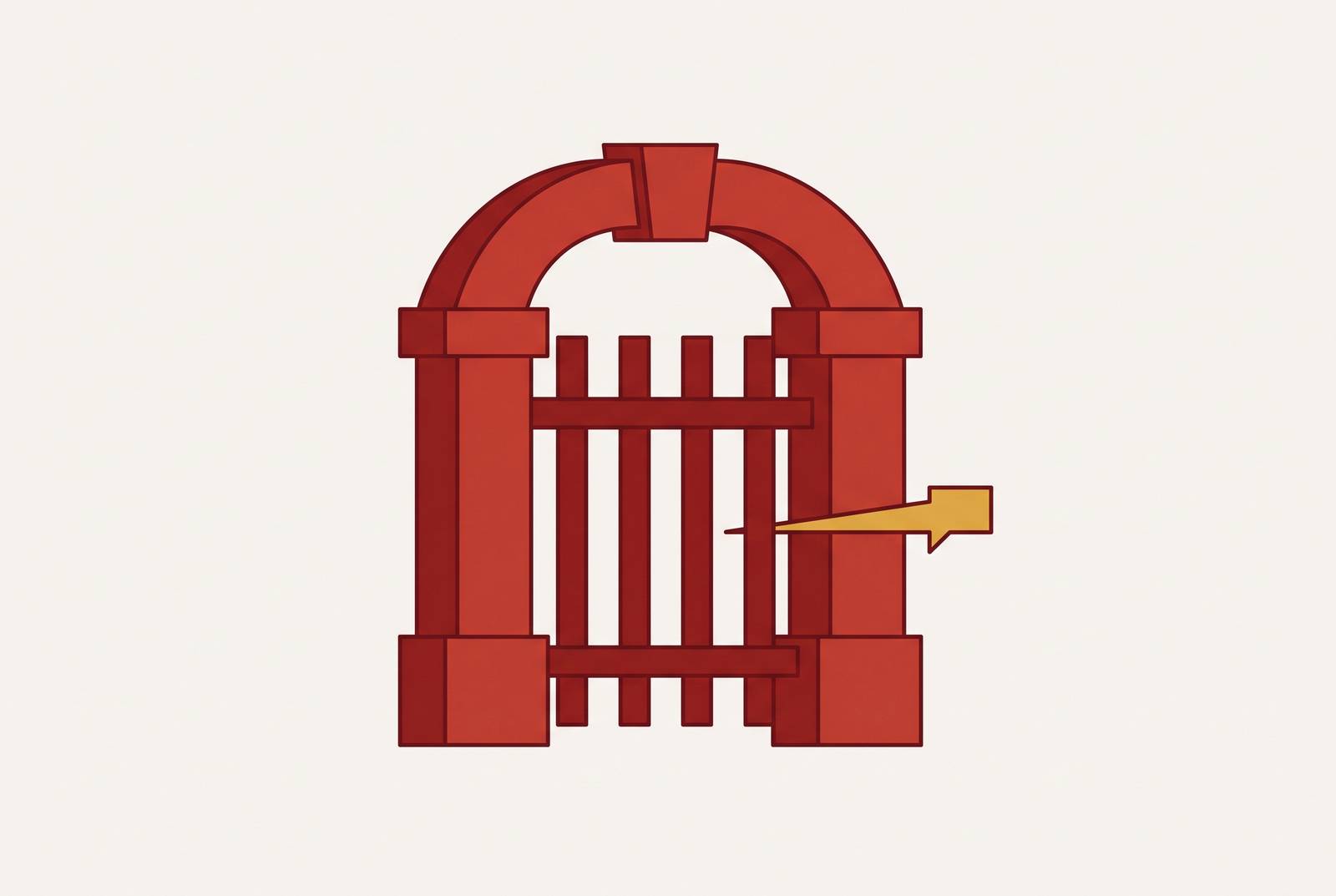
Three forms of injection exist, and each one targets a different point of trust.
Direct injection is the original version: someone types the malicious instruction straight into the prompt or the API call. It still works against frontier models, because catching novel phrasing and obfuscation is a moving target no filter has closed for good. Indirect injection is worse, for a specific reason: the attacker never touches the chat window. Instructions get buried in content the model reads on someone else's behalf, an email, a PDF, a web page, a record a RAG pipeline pulls back, a calendar invite. The user asks a plain question, the agent goes and fetches supporting material, and the malicious instruction rides in with it, unnoticed. Stored injection pushes this further into time: the payload sits written into long-term memory, a knowledge base, or a document, untouched until some future query wakes it up. A single-session risk turns into a persistent one that can wait months for the right trigger.
Prompt injection is not jailbreaking, and treating the two as interchangeable hides what's actually dangerous about the second one. Jailbreaking targets the model's alignment, meaning what it will refuse to say out loud. Prompt injection targets the application layer: what the system actually does with the tools and data it can reach. Jailbreaking is really a subset of direct injection, a special case aimed at safety training rather than at business logic. Security researchers have framed the goals as twofold: goal hijacking, where the attacker forces the model to run a task it was never meant to perform, and prompt leaking, where the attacker gets the model to reveal hidden system instructions or other data it was told to keep private.
Indirect injection is the form that should worry defenders most, more than the other two combined. It needs no credentials and no direct system access, nothing beyond patience. The attacker plants the payload somewhere a legitimate user's agent will probably read eventually, then waits for that agent to do the damage on its own, with the user's own credentials attached to every step.
The authorization bypass mechanism: why injection escalates from manipulation to privilege
An injected instruction only needs to reach a model that already holds valid credentials. Once it does, it rides those credentials wherever they lead. That's the entire mechanism, and it's what turns a text-processing quirk into an authorization problem instead of a phrasing problem.
Picture the agent as an insider with full badge access. It behaves like a trusted employee because, functionally, it is one: real permissions, real API keys, real write access to real systems. Its instructions can come from an external attacker instead of its actual operator, and the agent has no way to tell which one issued them. An agent wired into Salesforce, Microsoft 365, and Workday at the same time doesn't put one account or one dataset at risk. It exposes the combined authority of every permission across all three systems simultaneously, because a single injected instruction routed through that agent inherits all of it at once. Obsidian Security reports that AI agents move roughly 16 times more data than a human doing comparable work. That volume is what turns one compromised agent from an isolated incident into an exposure event with real weight behind it, fast, before anyone notices the pattern.
What the attack success data shows about the reliability of this vector
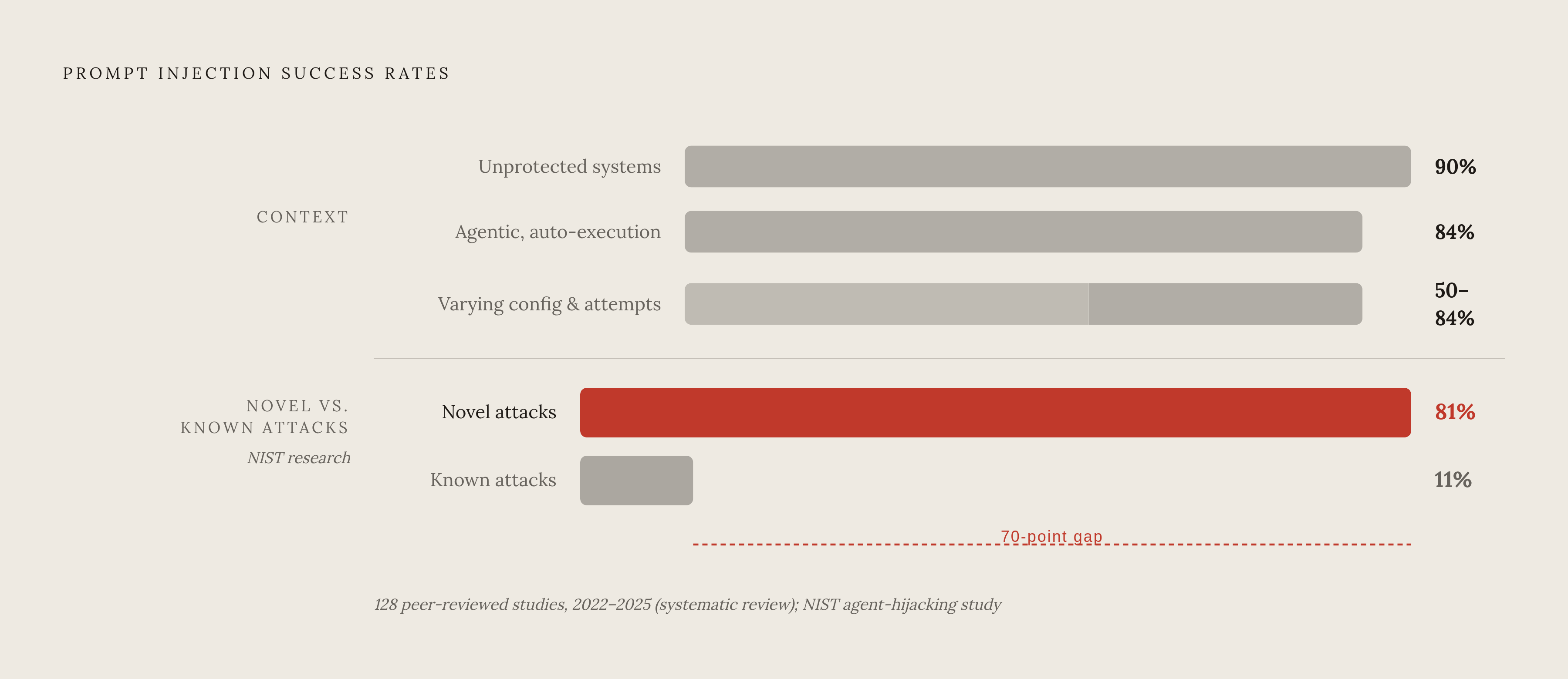
The headline number is stark on its own: attack success rates running from roughly 50% to 84%, depending on system configuration and how many attempts the attacker gets. The upper end is the measured rate against agentic systems running auto-execution, which happens to be the exact configuration enterprises are racing to deploy right now, not some edge case nobody uses.
Sit with the low end for a second too. Even at the bottom of that range, an attacker who gets a few tries against a realistic production system holds better-than-even odds, a coin flip stacked in the attacker's favor from the start. Pick whichever number feels conservative; none of them favor the defender.
A systematic review synthesizing 128 peer-reviewed studies published between 2022 and 2025 found attacks against unprotected systems clearing a 90% success rate. The same review traces a clear arc: simple direct injections early on, then a push toward increasingly sophisticated multimodal attacks that target unprotected systems. Separately, NIST research comparing novel agent attacks against known baselines found the novel attacks reached an 81% task-hijacking success rate, against just 11% for the known ones. That gap of roughly 70 points is the real story here. It shows how much room attackers still have the moment they step outside the techniques defenders have already catalogued and trained against, and it argues against any confidence that current defenses generalize.
Production incidents that moved prompt injection from research to breach record
The timeline runs from proof-of-concept curiosity to confirmed enterprise breach, and it moves fast once agents start touching real infrastructure.
Start with Bing Chat, back when Microsoft's AI-powered search assistant carried the internal codename "Sydney." A Stanford researcher used a simple override prompt, nothing exotic, and pulled out the system's internal instructions, its codename, and hidden guidelines Microsoft never meant to expose. This moment became one of the earliest public markers that injection was a real threat rather than an academic worry.
Demonstrated attacks against enterprise RAG systems have shown how the mechanics work. Researchers embedded malicious instructions inside a publicly accessible document, no special access required. Once the AI system retrieved that document during normal operation, it leaked proprietary business intelligence to external endpoints, rewrote its own system prompts to switch off its safety filters, and made API calls carrying elevated privileges it should never have exercised on the attacker's behalf. The failure was simple: the system treated everything it retrieved as equally trustworthy, whether that content came from a vetted internal source or a public document anyone could edit.
Then came EchoLeak, tracked as CVE-2025-32711 and rated 9.3 on the CVSS scale, close to the maximum severity a vulnerability can carry. Aim Security disclosed it in mid-2025 as a critical zero-click data exfiltration attack against Microsoft 365 Copilot. Nothing about the attack path required the victim to do anything wrong. An attacker sent an ordinary email to the target. The user never needed to interact with the malicious content directly, and a later, completely unrelated query from the user triggered the exfiltration of organizational data. The attack slipped past Microsoft's cross-prompt injection classifier and pulled data out remotely, with no authentication required at any step. Sources covering the disclosure noted that before EchoLeak, attacks of this shape were treated as largely theoretical, something researchers warned about but nobody had caught in the wild. EchoLeak closed that gap for good, and it did so without the victim clicking on anything.
MCP, agentic architectures, and the expanded injection surface in enterprise systems
The Model Context Protocol, MCP, has become the standard way agents connect to CRMs, databases, ticketing systems, and the rest of the SaaS stack an enterprise runs on. That standardization is why the risk keeps climbing: every tool exposed over MCP is also a fresh injection surface, and the count of those surfaces grows with every new integration a team ships.
The architecture produces the risk directly, not as a side effect. Tool outputs get passed straight into the model's context window, the same window carrying the user's instructions and the system prompt. Earlier-generation chatbots, the kind that mostly answered questions from a fixed knowledge base, never had this problem at this scale, because they weren't reaching out to live systems mid-conversation. Once an agent is wired up to live tools, external data and model instructions start sharing a single stream, and the model has no reliable way to sort out which parts of that stream deserve trust.
The state of MCP servers already deployed backs this up with hard numbers. A security firm scanning popular MCP servers found that 43% carried command-injection flaws, 22% allowed path traversal or arbitrary file reads, and 30% could be exploited through server-side request forgery. The scale of vulnerable servers across all three categories points to systemic gaps in how MCP infrastructure is being deployed and configured. The injection surface wasn't theoretical here. It was sitting exposed on live infrastructure, waiting for someone to notice.
Governments have started responding in kind, which tells you how seriously the intelligence community now takes this. By 2026 the problem had grown serious enough that the NSA published formal design guidance specifically for securing MCP deployments. Then in May 2026, the Five Eyes intelligence alliance, made up of CISA and the NSA alongside counterparts in the UK, Canada, Australia, and New Zealand, issued joint guidance on agentic AI that named prompt injection outright as a core manipulation vector. That's a real escalation: a vulnerability class that started as a curiosity in a chatbot transcript is now the subject of coordinated guidance from five national security agencies. The mechanism hasn't changed since the Bing Chat leak. What changed is the blast radius, now that agents hold real credentials across real enterprise systems, and the list of organizations finding this out the hard way keeps getting longer.